Introduction:
In 2026, businesses are going at a faster pace than ever before. Gone are the days of relying on out-of-date spreadsheets, reports that are too late, or systems that are not connected in making important decisions. In today’s highly dynamic business landscape, it is essential for organizations to have quick access to reliable business data to compete with everyone else. In this regard, ERP Software is proving to be a game-changer.
Today, ERP systems offer end-to-end visibility across all business processes – from finance to inventory, HR to customer management, and beyond. This eliminates the need for end-of-day reports or having to manually combine data from various departments, giving decision-makers instant access to updates and to take action when it’s needed.
ERP systems are now more powerful than traditional business software, with the increasing use of intelligent automation and cloud connectivity, as well as AI-powered analytics. New ERP tools are helping businesses across all industries minimize delays in operations, increase productivity and make better business decisions.
Real-Time ERP Software – what is it?
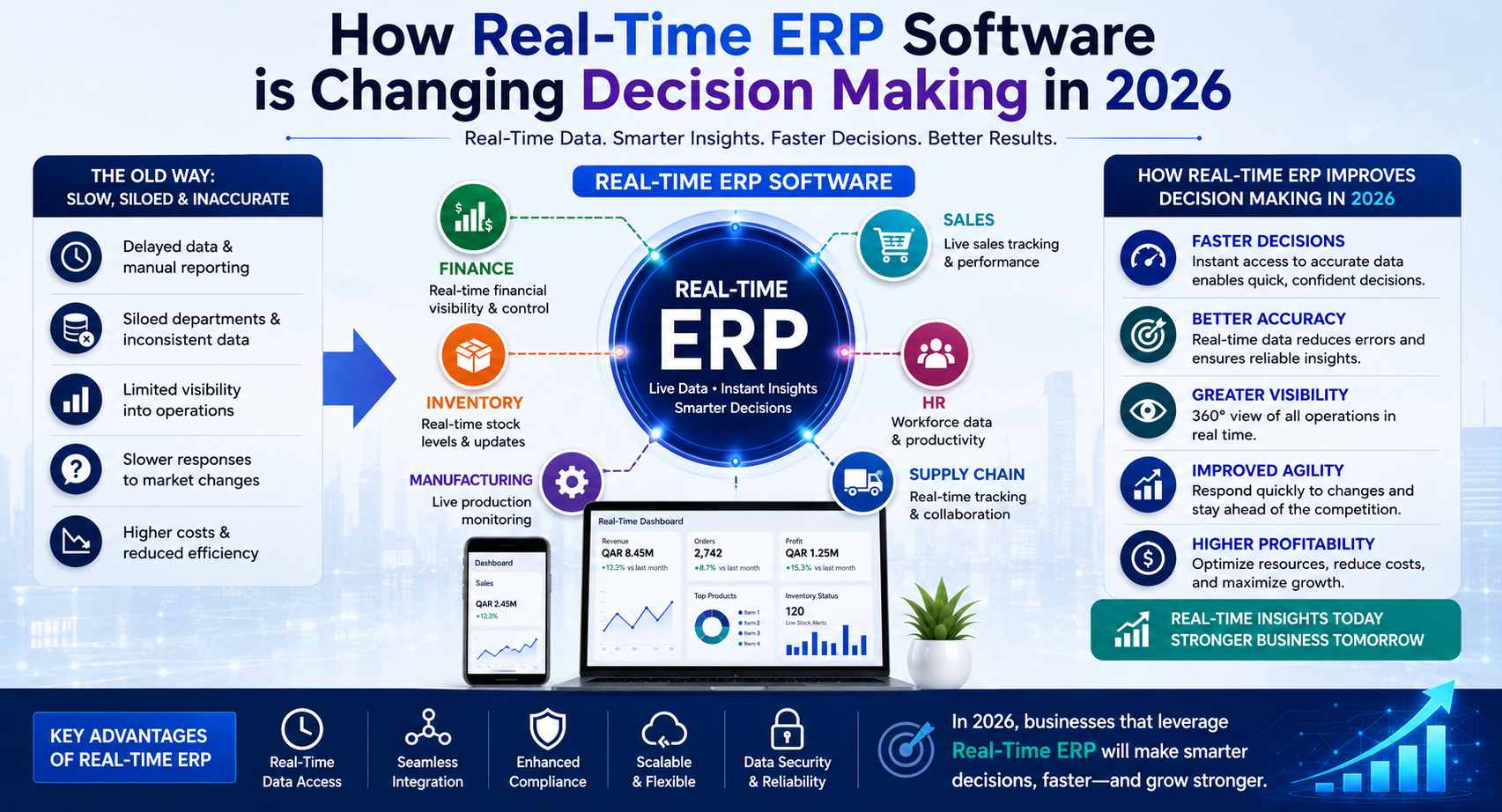
Real time ERP software are ERP systems that gather and process business information on the fly, and update them in real-time throughout the business. Traditional ERP systems usually process data in batches or manually, whereas modern ERP systems offer real-time business insights as business activities happen.
Whenever a sale occurs, inventory is updated, an employee logs attendance or a payment is made, the system updates automatically throughout the organization. This helps management teams to be able to keep an eye on operations without any delay.
Today’s ERP solutions combine a variety of business functions into a single system such as:
- Accounting and finance
- Human resources
- Inventory management
- Procurement
- Sales and CRM
- Manufacturing
- Supply chain management
All departments share the same environment, making it easier for business to see what is going on and to have better team coordination.
Some of the ways ERP Software enhances decision making are:
Quickly retrieve accurate data:
The most significant benefit of ERP Software is the capability to have access to the accurate information in a flash. Delayed reporting in many organizations results in slow decision-making process. Outdated reports that don’t accurately show the true picture of the business are commonly used by managers.
Real-time ERP systems overcome this issue by offering real-time dashboards and automation for reporting. Real-time tracking of revenue, stock, business expenses and employee performance is available to business leaders.
These enable organisations to:
- Be responsive to changes in the market place.
- Immediately recognize any issues related to operations
- Improve forecasting accuracy
- Reduce financial risks
Use data to help make informed business decisions.
Accurate and reliable data enables executives to make informed decisions and move towards strategic planning without making guesses.
Modernization with ERP Software Deutschland—Digital Transformation:
ERP Software Deutschland continues to be in demand, as businesses in Germany are making significant efforts to transform themselves into digital companies. German companies are interested in becoming efficient, compliant, automating and intelligent in business operations to compete in the international markets.
ERP solutions are gaining traction in manufacturing companies, retail, logistics and service companies alike, as they find these systems to be more efficient in operations and business intelligence.
Understands the need for ERP systems in Germany, these organizations would prefer:
- Real-time reporting
- GDPR compliance
- AI-driven analytics
- Cloud accessibility
- Advanced workflow automation
The advent of Artificial Intelligence ERP Software:
AI is one of the most crucial elements in today’s ERP solutions. Ai ERP Software is reshaping business data analysis and operational decisions, revolutionizing the way companies use data for informed decisions.
Currently AI enabled ERP systems can:
- Forecast sales in the future
- Detect financial anomalies
- Automate repetitive tasks
- Recommend inventory adjustments
- Improve workforce planning
- Analyze customer behavior
The capability enables businesses to take proactive steps instead of reactive measures once issues arise.
For instance, AI can study the past sales data and anticipate demand surges prior to they occur.
The need of having an ERP system in 2026:
Growing businesses can no longer afford not to have an ERP System. Businesses using stand-alone applications may experience inefficiency, lack of communication, and reporting inaccuracies.
Today’s ERP systems can help companies to streamline operations and integrate all departments into a single workflow. This enhances teamwork and communication, and allows each team to have access to the latest information.
Some of the Most Important Advantages of ERP Systems are:
Improved Operational Efficiency:
By automating tasks, you can save time and prevent data entry duplication. Staff will be able to concentrate on strategy rather than on administrative tasks.
Better Collaboration:
All business functions are linked to a centralized system which makes information sharing easy between departments.
Enhanced Customer Experience:
Customer history, order information and the history of the communication can be accessed by the sales and customer support teams at a single stroke of the mouse.
Greater Business Visibility:
Executives have 100% visibility into operations with real-time dashboards and reporting.
Enhanced compliance and Security:
By facilitating regulatory adherence and enhancing data security and access control, ERP systems play a crucial role in ensuring successful business operations.
With the growing competitiveness of business environments, companies are more and more relying on ERP systems to enhance business agility and future development.
Cloud ERP Software is Paving the Way for Remote Business Operations:
Cloud ERP Software is being in demand due to the popularity of remote work and working across the globe. The cloud ERP systems enable employees to have access to business data securely irrespective of their location.
Cloud ERP systems have a number of benefits:
- Lower infrastructure costs
- Faster implementation
- Automatic software updates
- Improved scalability
- Remote accessibility
- Enhanced disaster recovery
It is a cloud-based ERP system, which means that it can be used by businesses in real-time, irrespective of the locations.
How real-time ERP Supports Financial Decision Making:
One of the most important functions in which ERP systems increase the decision making process is in financial management.
Reporting in the traditional financial reporting process can be delayed due to manual reconciliation and siloed accounting systems. Real-time ERP opens up the door to solving these problems by maintaining a constant up-to-date financial record.
This helps businesses:
- Get real-time cash flow tracking.
- Track expenses accurately
- Create and calculate real-time profit analysis.
- Improve budgeting decisions
- Reduce accounting errors
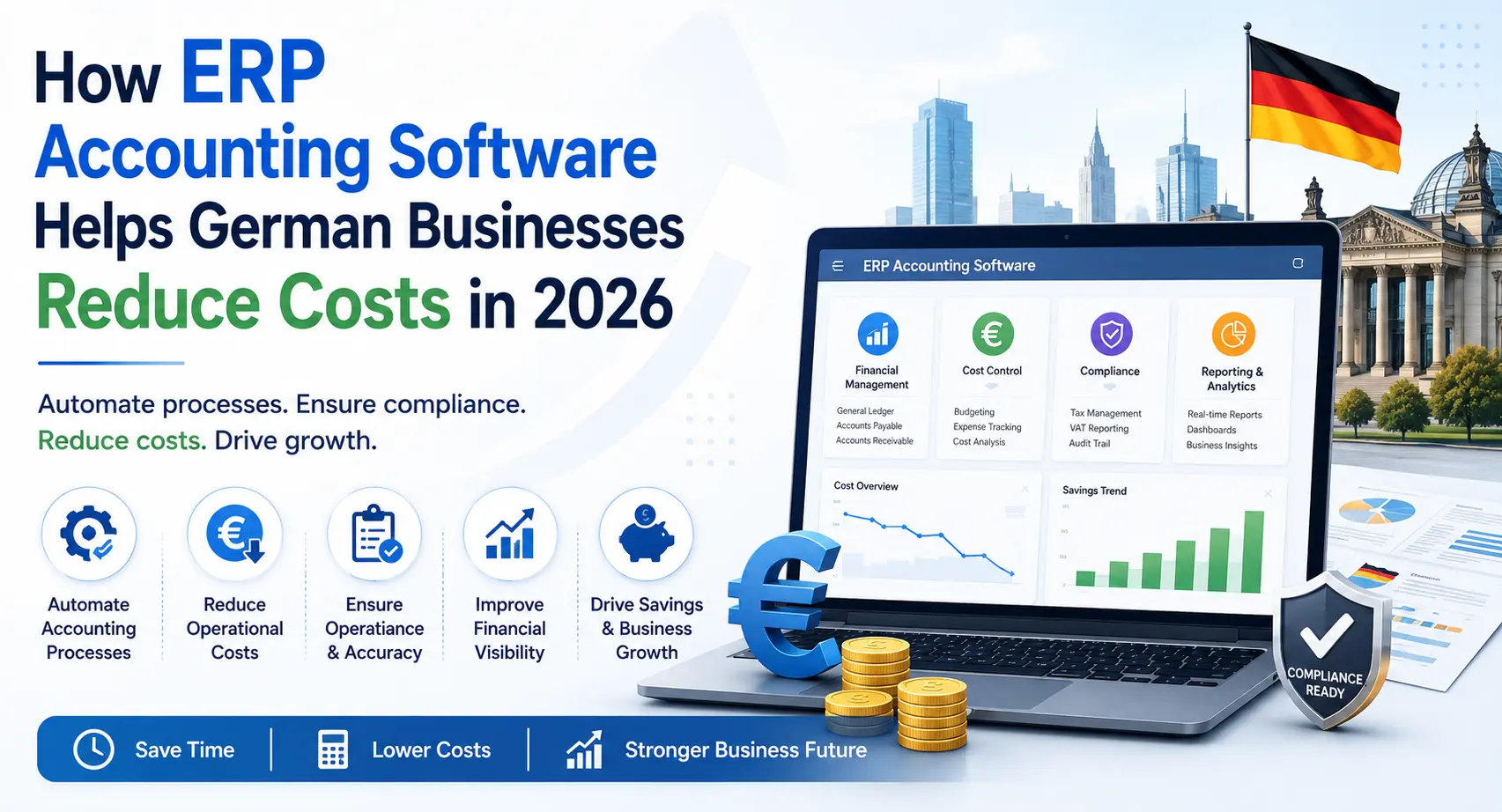
Today’s erp accounting software also offer more sophisticated forecasting capabilities to better forecast future financial results.
An ERP accounting system can help businesses easily detect trends in profitability, areas of inefficiency and potential cost savings.
In 2026, AI-driven data and dashboards in ERP systems will be fully used for strategic financial planning, reducing manual tasks and human oversight.In 2026, financial leaders will be using a lot of ERP dashboards and AI-driven data to guide their strategic financial planning, minimizing manual work and human oversight.
The role of ERP Software in Inventory Decision Making:
The challenges of inventory management have increased as a result of the disruptions in the global supply chain and the changing pattern of customer demands.
Real-time ERP software enables businesses to have the correct visibility of inventory in warehouse, retail stores, and distribution centers.
ERP systems can enable businesses to:
Implement inventory tracking in real time.
- Reduce stock shortages
- Avoid overstocking
- Improve warehouse efficiency
- Forecast inventory demand
AI-driven ERP systems can also glean insights from past purchase patterns and suggest ideal inventory levels, derived from market demand and trends.
This helps to optimize the operation and reduce the amount of stocks.
Real-time inventory visibility is crucial for manufacturing and retail businesses to ensure they keep their operations running smoothly and satisfy their customers.
How ERP connects with HR Software:
In recent years, ERP systems have been increasingly connected with the hr software, as a way to boost the productivity of employees and the administration of workforce.
HR departments can now deal with:
- Payroll processing
- Employee attendance
- Recruitment
- Performance evaluation
- Leave management
- Compliance reporting
The integration of HR systems in ERP enables organizations to have improved visibility of their workforce and better operational coordination.
Managers can run an instant analysis of staffing needs, labor costs and employee performance data. This enables companies to make better use of their people in alignment with their business goals and minimize administration waste.
What’s to come in ERP Software in 2026?
Intelligence, automation and predictive analytics are the focus of the future of ERP technology.
As businesses seek to streamline operations and gain a competitive edge in today’s fast-paced world, they are turning to ERP systems that integrate:
- Artificial intelligence
- Machine learning
- Cloud computing
- IoT integration
- Predictive analytics
- Mobile accessibility
These innovations are making ERP systems more than just operational tools and are helping companies make better decisions.
Over the next few years, ERP systems will be even more customized, flexible and self-learning. ERP technology will not just enable businesses to manage their operations, but also for their long-term strategic growth.
Early ERP modern adopters will reap many efficiency, customer and business intelligence benefits.
Conclusion:
In 2026, real-time ERP technology is driving the transformation of business operations and decision making. There is no longer a need for organizations to have to rely on late reporting or disjointed systems to manage operations.
Today’s ERP solutions offer real-time data on financial management, stock control, HR, sales and supply chain. ERP systems can now be combined with AI and cloud technology to help businesses to make quicker, smarter and accurate decisions.