The way ERP Accounting Software can be useful in 2026 to help German Businesses save on costs:
In 2026, German businesses are under more pressure. Increased labor expenses, tightened financial controls, uncertainty in the economy and increased competition are compelling firms to be smarter in conducting their operation. Due to the need to find effective solutions that will enhance efficiency and sustain profitability, ERP Accounting Software is becoming a viable choice among many organizations.
ERP is no longer the preserve of big organizations. ERP systems provide a method today through which companies of any size have automated their financial processes, decreased the amount spent on administration, provided higher accuracy in reports, and provided the company greater control over company resources.
This blog examines the introduction of ERP Accounting Software as a means to help reduce cost and enhance financial performance of German businesses by 2026.
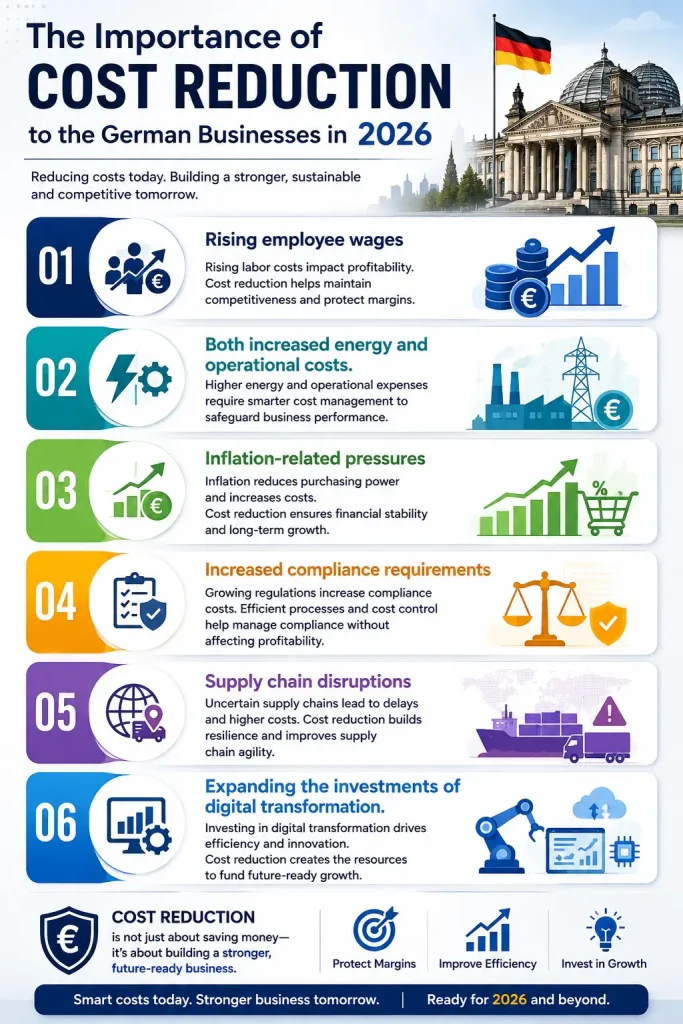
The importance of cost reduction to the German businesses in 2026:
Weakness of the companies So far, Germany is among the most robust economies in Europe, and the companies are faced with a number of financial challenges, such as:
- Rising employee wages
- Both increased energy and operational costs.
- Inflation-related pressures
- Increased compliance requirements
- Supply chain disruptions
- Expanding the investments of digital transformation.
In order to compete in the market, organizations need to find out areas in which they are able to reduce costs without compromising the productivity and customer satisfaction. This is where ERP Accounting Software will be a useful business tool.
ERP Accounting Software What is ERP Accounting Software?
ERP Accounting Software is a financial management application that is incorporated into an Enterprise Resource Planning. It cohesively integrates accounting, finance, purchasing, inventory, payroll and business processes on one platform.
Companies are then able to employ a single central platform where all the financial activities can be managed as opposed to various disconnected systems. This increases visibility, minimizes repetition of work and improves decision making.
An accounting platform based on ERP usually incorporates:
- General ledger management
- Accounts payable
- Accounts receivable
- Budgeting and forecasting
- Tax management
- Financial reporting
- Payroll integration
- Cash flow monitoring
These functions can be very useful to the businesses in that the cost of operations can be minimized and efficiency can be enhanced by having all these functions in a single central location.
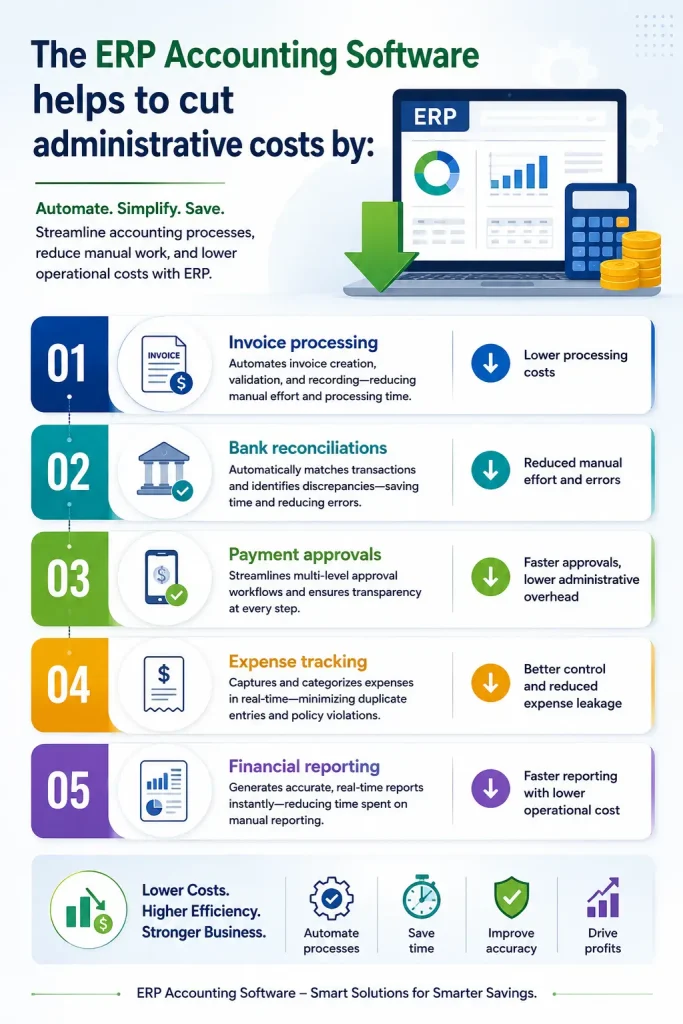
The ERP Accounting Software helps to cut administrative costs by:
Administrative work is one of the largest costs of most organizations. Performing manual accounting processes wastes good quality employee time and can tend to create expensive errors.
ERP Accounting Software automates repetitive activities like:
- Invoice processing
- Bank reconciliations
- Payment approvals
- Expense tracking
- Financial reporting
Automation saves the time-consuming manual data entry and enhances accuracy.
Employees are able to concentrate on strategic things rather than using hours in handling spreadsheets and documentation. This means that companies are able to have lean finance departments whilst maintaining a high level of productivity.
Accounting ERP Improves Financial Accuracy:
Mistakes in finance may be very costly. Penalty and lost revenue may be based on incorrect bill, redundant payment, mistransmission of taxes and inaccurate records.
Most of these risks can be removed by Automation and real-time validation that is made possible by an Accounting ERP system.
Benefits include:
- Reduced human errors
- Automatic calculations
- Consistent financial records
- Improved audit readiness
- Accurate tax reporting
German companies with their operations in highly regulated environments, proper monitoring of financial records is essential. ERP systems assist in assuring that they comply with it as well as minimizing the expenses of rectifying the accounting errors.
The ERP Software of Accounting is a facilitator of Business Processes:
Most companies continue to implement individual software packages to provide accounting, inventory, procurement, payroll and customer management.
Accounting ERP Software is a Unified System that involves all departments in the system, information flows through the system in a unified manner.
For example:
- The inventory is automatically updated with sales orders.
- Back shop adjustments update the purchasing requirements.
- Purchases are recorded in accounting records.
- Payroll costs are automatically registered in the financial reports.
- This integrated surrounding decreases duplication, elimination of needless manual effort, and decreases operations costs.
ERP Accounting Improves Management of Cash Flows:
- One of the most crucial aspects of business success is cash flow.
- Companies that fall short are those who do not have real-time information about payments due, payments given and money owed.
ERP Accounting systems enable managers to have detailed financial dashboards, which enable them to:
- Monitor incoming payments
- Track overdue invoices
- Manage supplier payments
- Make predictions of future cash needs.
- Identify spending trends
Optimal cash flow management assists companies to escape the wasteful expenditure incurred in borrowing funds and enhances financial planning.
Financial risk can be diminished greatly by having a healthy cash flow in a volatile economic environment.
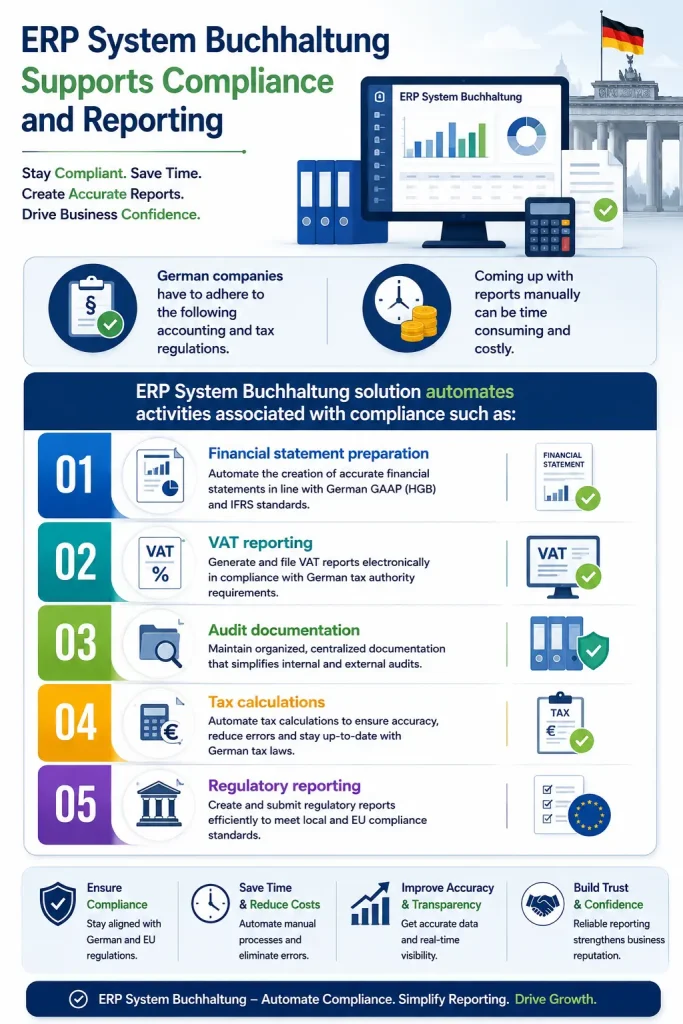
ERP System Buchhaltung Supports Compliance and Reporting:
- German companies have to adhere to the following accounting and tax regulations.
- Coming up with reports manually can be time consuming and costly.
ERP System Buchhaltung solution automates activities associated with compliance such as:
- Financial statement preparation
- VAT reporting
- Audit documentation
- Tax calculations
- Regulatory reporting
Since every financial information is in one centralized system, organizations are able to get quick and accurate reports.
This minimizes the cost of preparing audits and reduces a chance of the penalty of non-compliance.
ERP Cloud Lowers the cost of IT Infrastructure:
Conventional on-premise accounting systems can be very costly in hardware, maintenance and IT staff.
ERP Cloud solutions are more affordable.
Cloud based ERP systems ventures honesty:
- Lower upfront investment
- Reduced hardware expenses
- Automatic updates
- Improved security
- Remote accessibility
- Lower maintenance costs
Only the resources required are paid by the businesses, so cloud ERP in particular is appealing to smaller and medium-sized businesses.
Cloud ERP is also rapidly gaining ground with an increasing number of German organizations adopting digital transformation.
Enhanced Inventory Management eliminates Waste:
Costs can be created by inefficiencies in inventory.
Overstocking causes the current working capital to be tied up, whereas the inability to get a stock can result in the lost sales.
ERP Accounting Software is a combination of inventory and financial data that gives real-time access to data about inventory and purchasing operations.
Benefits include:
- Better inventory forecasting
- Reduced storage costs
- Lower waste levels
- Improved procurement planning
- Enhanced demand forecasting
Companies will be in a position to make smarter buying choices and save unproductive inventory costs.
Superior Business Intelligence results to smarter Decisions:
Outdated reports or incomplete information are used to make decisions in many companies.
ERPs enable real-time analytics and financial reporting, which aid in making improved decisions.
Managers can analyze:
- Revenue trends
- Profitability by product
- Departmental expenses
- Customer profitability
- Operational costs
Businesses are able to find opportunities that will help save them money more quickly because the accurate information is readily available.
The decision-making capacity based on data may frequently result to dramatic savings in the long-term.
How AI will empower ERP Accounting in 2026:
AI is revolutionizing ERP systems throughout Germany.
Insourcing advanced AI ERP Software options that improve accounting processes is being undertaken by many organizations.
The advantages of AI-powered ERP are:
- Predictive financial forecasting
- Automated invoice recognition
- Fraud detection
- Smart expense categorization
- Cash flow prediction
- Automated financial recommendations
The technologies also minimize human labor, as well as increase the accuracy of financial information and decision-making.
ERP solutions will become even more instrumental in assisting businesses to reduce expenses as AI adoption is on the rise.
It is the case because ERP Accounting helps Small and Medium Businesses:
ERP systems are now not only accessible to big companies.
The new ERP systems are both scalable and less expensive and can also be used by small and medium-sized enterprises.
SMBs benefit through:
- Reduced accounting workload
- Better financial visibility
- Improved compliance management
- Lower operational costs
- Faster reporting
- Increased productivity
ERP Accounting Software is capable of bringing quantifiable financial gains, whether a company has 20 staff members or even 2,000.
Choosing the Right ERP Accounting Software:
In choosing an ERP solution, it is important to look at:
- Industry-specific requirements
- Scalability
- Cloud capabilities
- Integration options
- Compliance support
- Reporting features
- AI functionality
ERP Accounting Software considerations should also be made by the organization to align the software with their larger (digital transformation) strategy.
ERP Software solutions that are compatible with the ERP Software Deutschland needs, Human Resource Software solutions, Cloud ERP Software settings and AI ERP Software solutions tend to offer the top ROI.
Conclusion:
German companies are increasingly being pressurized to work more efficiently and keep down costs in 2026. ERP Accounting Software offers an effective solution through automation of the financial processes, enhancing accuracy, compliance and providing real time business information.
ERP system can create significant cost savings in several areas of the business, whether by lowering administrative expenditures, bettering cash flow management, utilizing AI-based automation or cloud-based savings.
Modern ERP Accounting tools invested in by companies today will help them be better placed to stay competitive, compliant and profitable in the changing business environment in Germany.
Frequently Asked Questions
ERP Accounting Software saves on the expenses by automation of financial accounting functions, enhancing financial accuracy, lessening accounting risks, lowering administrative workloads and providing real-time information to aid decision-making.
German companies are also confronting the increasing labor cost, cost of operation, strict regulation and economic uncertainty. Cutting on wasteful costs will enable organizations to be profitable and competitive.
ERP systems are able to minimise labor costs, administrative costs, compliance costs, inventory carrying costs, IT infrastructure costs, reporting costs and losses due to accounting errors.
Yes. Recent ERP tools can scale up to small, medium, large enterprises. ERP systems implemented on the cloud are simpler and more affordable than ever.
The savings will depend on the size of business, the industry and implementation quality. But numerous organizations indicate substantial decrease in administrative costs, manual processing costs and inefficient operations following the application of ERP Accounting solutions.
Author
-
Adil Merchant is a Marketing & Sales strategist passionate about helping businesses grow through smart selling techniques. He writes about proven sales strategies inspired by the world's top sales thinkers. His blog is dedicated to turning complex sales concepts into simple, actionable tips. Whether you're a beginner or a seasoned professional, Adil's insights are designed to sharpen your skills and boost your results.