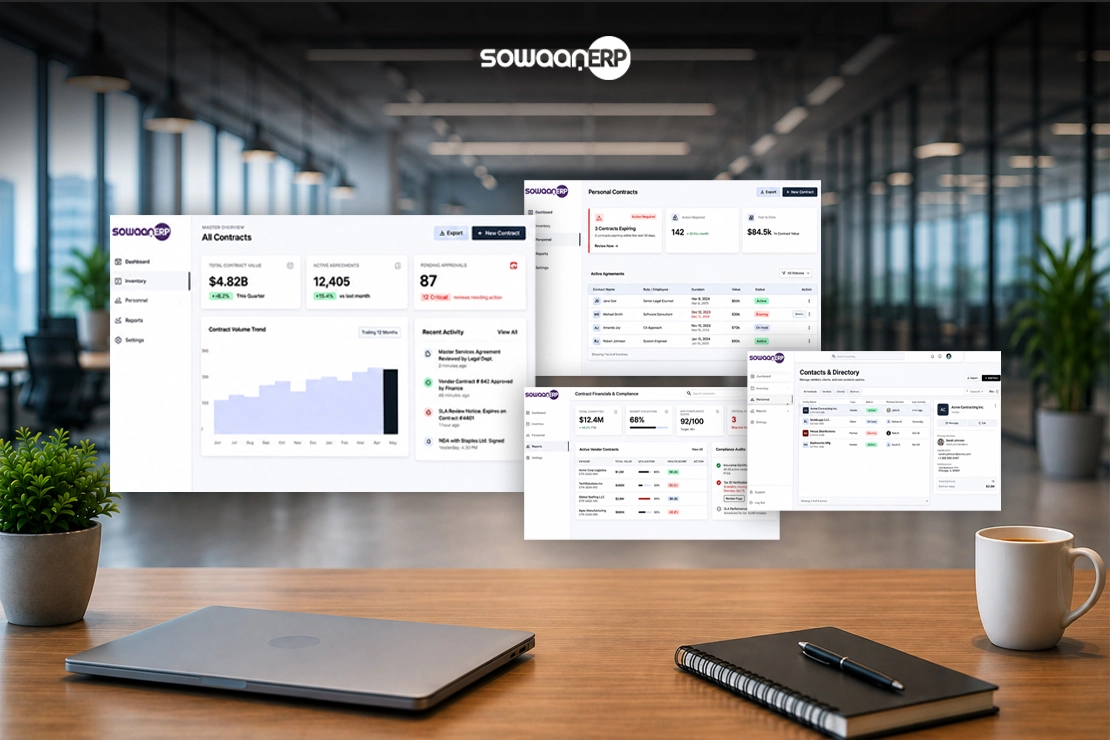
What Is Contract Lifecycle Management Software? How AI Is Powering Contract Intelligence in 2026
3.2 million German SMEs. Millions of contracts. However, how many businesses truly are aware of which agreements are expiring, which obligations are outstanding or where the latest approved version is?
According to Germany’s Federal Statistical Office (Destatis), in 2023 SMEs accounted for 99.3% of the enterprises included in the structural business statistics in Germany.
The difficulty is not in drafting a contract, it’s getting everything right before and after they sign it. CLM Software gathers requests, approvals, negotiations, obligations and renewals into a control digital workflow, and AI can convert contract data to business intelligence.
Contract technology is evolving from a document repository to a layer of business data that bridges agreements with finance, procurement, sales, HR, compliance and operations..
ℹ️
Market signal
What Is Contract Lifecycle Management (CLM) Software?
Contract Lifecycle Management Software helps an agreement throughout its lifecycle from the first request to drafting, negotiating, when it is signed, monitoring, renewal and archival.
The difference is crucial, as CLM is not just a digital filing cabinet.
- Contract request and intake forms.
- Approved clause libraries and templates
- Version control and redlining
- Role-based approval workflows
- E-signature integration
- Contract metadata management
- Alerts on renewal/expire date
- Bond tracking
- Searchable contract repositories
- Audit histories
- AI-assisted contract analysis
CLM definition and lifecycle framework describes CLM as managing contracts from initiation through execution, performance and renewal or expiry.
CLM vs. Contract Management Software : What’s the Difference?
Best contract lifecycle management software can be mostly geared toward holding agreements, keeping dates and dealing with documents.
CLM takes it one step further, by linking pre-signature and post-signature activities. It should enable a business to decide where an agreement is located and also:
- Who requested it?
- Which clauses changed?
- Who approved it?
- What obligations exist?
- At what time can it be canceled?
- What are the monetary obligations?
This is why contract management lifecycle software is especially beneficial in cases where contracts directly impact revenue, accounting, or operational delivery, as well as procurement.
Looking for contracts to be worked in parallel with finance, HR, procurement and other business processes? Discover how SowaanERP can be beneficial in building a connected ERP environment.
Book a Demo
Ready to get started?
The 7 Stages of the Contract Lifecycle
The average lifecycle of a structured lifecycle consists of seven key phases: initiation, authoring, negotiation, approval, execution, obligation management, and renewal/analytics.
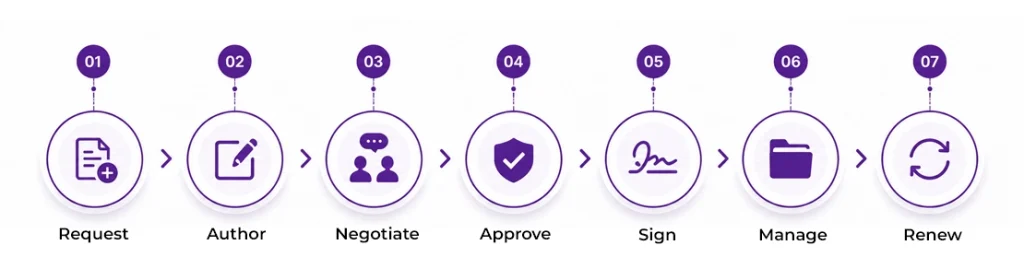
1. Request & Initiation
The lifecycle begins with a need for a new agreement, amendment or renewal, within a department.
The intake process can record:
- Contract type
- Counterparty
- Business owner
- Estimated value
- Start and end dates
- Department
- Risk category
- Required approvals
This provides legal, procurement and finance teams with a frame of reference prior to writing.
2. Authoring & Clause Libraries
Authoring is the transformation of the request into a controlled agreement.
Recurring contracts, like supplier agreements and customer agreements, NDAs, and service agreement contracts can be standardized using reusable templates. Clause libraries can provide approved language for confidentiality, payment terms, liability, termination and data protection.
While AI can help with initial drafting, it is advisable to have the appropriate human review of legally sensitive language for comparison.
3. Negotiation & Redlining
Version control is essential in negotiations.
A modern platform should keep track of the negotiation history and provide a convenient view of versions. AI can help by searching for changes and potential violations of approved clauses, and summarizing content changes and any strange wording.
4. Approval Workflows
The approval rules should be in line with the actual risk structure of the organization.
For example:
Contract value → department → risk category → required approver → finance/legal review → final approval
The process for a low value standard supplier agreement does not always need to be a multi-year strategic outsourcing agreement.
5. Execution & E-Signature
With approval, the agreement begins to be implemented.
The system is to be kept:
- Final approved version
- Signature status
- Signatory information
- Execution date
- Related attachments
- Audit history
If e-signature is native or offered via integration, the signed contract should be automatically returned to the central contract record.
6. Obligation & Deadline Management
Signature is not the end of the lifecycle.
Post-execution obligations may include:
- Service-level commitments
- Insurance certificates
- Reporting requirements
- Payment milestones
- Price escalations
- Delivery obligations
- Data processing requirements
- Renewal notice periods
- Termination rights
Non-obligation tracking could then mean that valuable commercial information is never used in a repository.
7. Renewal, Analytics & Archiving
The last step is renewal decisions, performance analysis and controlled retention.
The platform should bring up upcoming expiries and notice periods well in advance of when they are due, so that responsible teams can take action. Portfolio analytics can also segment contracts by supplier, department, value, contract status, supplier risk, and/or renewal date.
Looking to eliminate departmental handoffs? Discover the value of an ERP-integrated approach when it comes to connecting approvals, documentation and operational workflows.
Book a Demo
Automate the Contract Lifecycle
Why German SMEs Need CLM Software
German SMEs tend to have rather thin legal, procurement and finance departments. This creates a significant risk for knowledge in contracts, as individual employees may hold knowledge in a variety of individual files, inboxes or spreadsheets.
Germany’s SME sector is a testament to the need for hands-on, scalable business software. According to the data from Destatis, 99.3% of the 3.2 million enterprises covered by its 2023 statistics were SMEs.
Common Pain Points: Spreadsheets, Missed Renewals, Compliance Risk
Typical warning signs include:
- The dates of the contracts are entered manually.
- There are several copies of the same contract.
- There is no central contract owner.
- Deadlines for renewal of documents found late
- Approval evidence out of order in email.
- Supplier terms without link to purchasing.
- Advance payments that are not incorporated into financial reporting.
- There is no standard clause library.
- Poor visibility throughout branches
- Slow reaction to audit/legal requests
Industries That Benefit Most
Industry | Relevant use cases |
Supplier, procurement, maintenance and service contracts | |
Professional services | Client, subcontractor and SOW agreements |
Supplier, service, employment and data processing agreements | |
Supplier, franchise, lease and service agreements | |
Construction | Subcontractor, project and maintenance contracts |
Technology | Customer, vendor, licensing and data-processing agreements |
Lease, property management and service contracts |
Growing beyond spreadsheets? Explore an integrated ERP environment that can bring finance, HR, procurement and other business functions together.
Build a Scalable Business Foundation
Ready to get started?
CLM Software and German Compliance: GoBD, GDPR and E-Invoicing
Document integrity, accessibility, auditability and controlled data processing are important software considerations when dealing with German compliance.
In July 2025, the Federal Ministry of Finance of Germany released another version of the GoBD. The BMF’s July 2025 update to GoBD focuses on updates to the principles for orderly management and the retention of electronic books, records and documents and data access.
Different types of records are subject to different retention periods in accordance with Section 147 of Germany’s Fiscal Code . General retention and availability requirements for retained documents and the rules on their readability are contained.
This is not to say that all contracts have to be ten years long. The period to which it applies is determined by the type of record and the law.
🔥
Important
GDPR Controls
Contract platforms can process names, contact information, signatures, employee information and other personal data.
A guide by the European Data Protection Board for Small and Medium Enterprises (SMEs) on the obligations of the controllers and processors in the context of the relevant contract obligations between the two.
German buyers should therefore assess:
- Role-based access controls
- Encryption
- Data minimization
- Processing agreements
- Subprocessor transparency
- Data export and deletion
- Audit logs
- International data transfers
- Retention and deletion controls
The principles of data protection by design and by default also feature in this assessment framework of the EDPB with regard to the implementation of privacy controls within business applications.
E-Invoicing Is an Integration Consideration
As mentioned, the e-invoicing rules are mandatory in Germany from 1 January 2025, but with consideration to some transitional arrangements.
According to the E-Rechnung (e-invoice) guidance from the German Federal Ministry of Finance , domestic businesses have had to be able to receive e-invoices since 1 January 2025. The issuing of e-invoices subject to transitional rules varies depending on the circumstances.
This implies contract architecture as the subsequent purchasing and invoicing activity is often dictated by the terms of the contract.
Looking for improved control over records, approvals and financial processes? Get an Accounting erp software and operation linkage.
Learn More
Strengthen Compliance-Ready Workflows
How to Evaluate CLM Software: A Buyer’s Framework
Not all contract lifecycle management software is created equal. Not every platform boasts the most features, but that doesn’t make it the best CLM software. It’s the system that fits the organization’s contract size, risk appetite, and current applications and compliance needs.
Scalability & Multi-Branch Support
Ask whether the platform supports:
- Multiple legal entities
- Multiple branches
- Different departments
- Multiple currencies
- Different approval rules
- Multilingual documents
- Country-specific workflows
- Increasing contract volumes
A German company looking to enter the gcc contract lifecycle management software market might just need other procedures, currencies, entities and regulations at some point in the future.
AI Capabilities & Contract Intelligence
AI is transforming CLM from a data store to an analytical layer.
The Contract Intelligence concept is to use AI and workflows to convert contract data into structured and actionable business information.
Useful AI capabilities include:
- Clause extraction
- Bond extraction
- Renewal-date identification
- Risk flagging
- Contract summarisation
- Clause comparison
- Natural language search
- Non-standard clause detection
- Metadata extraction
- Negotiation assistance
Adoption of AI is also progressing into legal workflows. Google expanded its artificial-intelligence-powered Gemini Enterprise platform with legal-focused features designed to help lawyers with repetitive and complex tasks on August 25th, 2026, according to Reuters . The Reuters article about Google’s move into legal AI is a reflection of the general trend of targeted AI solutions in legal business processes.
AI-generated analysis should remain decision support. Sensitive contractual decisions require appropriate human oversight.
⚠️
Warning
Integrations with ERP, Accounting & CRM
One of the top buyer considerations is integration.
A connected architecture could be:
CRM → Contract Request → CLM → Approval → E-Signature → ERP → Accounting → BI
For instance, a customer agreement can contain pricing, billing period, monetary unit, renewal clauses etc. If these terms are not editable within a PDF, finance teams might have to re-type them by hand.
That’s where ERP-native contract management can prove to be a strategic asset.
Selling companies considering ERP Software Deutschland should thus take a look at contract workflows and procurement, CRM, accounting, HR software , and reporting, rather than at contracts as a standalone legal application.
Compliance Depth & Audit Trails
During a vendor demo, ask the provider to demonstrate:
- Who changed a contract?
- What changed?
- When did the change occur?
- Who approved it?
- Which version was executed?
- Can earlier versions be recovered?
- Can permissions be restricted by role?
- Can audit information be exported?
A polished dashboard matters less than the underlying data model and auditability.
Total Cost of Ownership & Implementation Time
The price of CLM depends on the users, the amount of users’ contracts, AI use, integrations, migration, support and customization.
Use:
TCO = Licenses + Implementation + Integrations + Migration + Training + Support + Administration + Future Customization
A more complex enterprise deployment may not be necessary for a smaller SME. The same holds true if the business requires obligation management but selects a low cost document repository, which can lead to a second technology project in the future.
Choosing business software? Prior to buying, consider integration, security, scalability and compliance in addition to functionality.
Book a Free Demo
Evaluate More Than Features
Standalone CLM tool vs. ERP-Native Contract Management
Neither architecture is universally better. The right choice depends on the organization’s operating model.
Factor | Standalone CLM | ERP-native / ERP-connected |
Contract-specific depth | Usually high | Depends on platform |
Legal workflows | Often sophisticated | Configuration dependent |
Finance integration | Usually connector-based | Potentially native |
Procurement integration | Ecosystem dependent | Often closely connected |
Implementation | Separate project | Can form part of ERP rollout |
Data duplication | Potentially higher | Potentially lower |
Best fit | Complex legal operations | Integrated SME operations |
expansion | Add specialist systems | Expand through ERP modules |
Specialist CLM might be useful for a legal department with thousands of highly negotiated contracts.
Not sure if stand-alone CLM or ERP-native contract management is right for your business? Assess workflows and integrations with an ERP approach.
Book a Free Demo
Choose the Right Architecture
How AI Is Changing Contract Lifecycle Management
Traditional contract systems respond to:
“Where is the contract where?”
AI-powered systems are designed to solve more and more the following problems:
What must we do under this contract?
Check into a supplier contract that includes:
- 60-day renewal notice
- 5% annual price increase
- Service-level obligations
- Insurance requirements
- Payment milestones
The agreement is kept in a document repository.
Those terms can potentially be extracted into structured information through a contract intelligence layer:
Contract term | Structured information |
Renewal | Automatic |
Notice period | 60 days |
Price escalation | 5% annually |
SLA | Defined threshold |
Insurance | Required |
Owner | Procurement |
Financial connection | Supplier record |
The real value appears when that information triggers a business workflow.
Looking to go beyond document storage? Learn how to use an integrated business system to convert contract data into actionable workflows.
Book a Free Demo
Turn Contract Data Into Business Intelligence
How Much Does CLM Software Cost?
There are various pricing models for vendors, making there no universal CLM price.
The cost may vary based on:
- Number of users
- Number of contracts
- Contract volume
- AI consumption
- Storage
- E-signature transactions
- Integration requirements
- Implementation services
- Data migration
- Support
- Custom workflows
- Hosting model
This makes scalability and localization important when evaluating contract lifecycle management software vendors.
The global CLM software market is estimated to generate US$1.62 billion in revenue in 2024, and reach US$3.24 billion by 2030 , growing at 12.7% CAGR from 2025 until 2030.
The numbers are commercial market research estimates and not official government numbers.
Buyer Tip: Inquire if there are any features, integrations, storage, e-signatures and advanced reporting options included in the quoted license or if they are additional costs.
💡
Tip
Getting Started: Implementing CLM Software
The implementation should not start with uploading all the historical PDFs.
Step 1: Map the Current Process
Document who requests, drafts, negotiates, approves, signs, stores and monitors agreements.
Step 2: Classify Contract Types
Record, draft, negotiate, approve, sign, store and review agreements, with those requesting them.
Step 3: Define the Data Model
Identify the metadata that matters:
Owner + Counterparty + Value + Start Date + Expiry + Renewal + Notice Period + Risk + Department + Obligations
Step 4: Standardise Templates
Create approved templates and clause libraries before automating the process.
Step 5: Build Approval Rules
Use contract value, risk, department and type to determine the approval route.
Step 6: Migrate High-Value Contracts First
Prioritize active, financially significant and operationally important agreements.
Step 7: Integrate With Business Systems
Connect contract information with procurement, CRM, finance and reporting systems where there is a clear operational dependency.
Step 8: Measure the Outcome
Track:
- Contract turnaround time
- Approval cycle time
- Metadata completeness
- Renewal performance
- Contract search time
- Manual data entry steps
- Outstanding obligations
- Contracts under active management
Planning a contract-management or ERP implementation? Start with workflows, data and integration requirements, then configure the technology around them.
Contact Us!
Plan Your Implementation Properly
CLM Buyer Checklist for German SMEs
Find out the following before signing with a vendor.
Contract Operations
- Central repository
- Templates
- Clause library
- Version control
- Redlining
- E-signature integration
- Renewal alerts
- Bond tracking
AI
- Clause extraction
- Contract summarisation
- Risk detection
- Natural language search
- Human-review controls
- AI data governance policies
Security & Compliance
- Role-based permissions
- Audit trails
- Encryption
- Retention controls
- GDPR/DSGVO support
- Subprocessor transparency
- Data export and deletion
Integration
- ERP
- Accounting
- CRM
- Procurement
- HR
- BI/reporting
- API availability
Commercial
- Implementation fees
- Migration costs
- AI usage charges
- Storage limits
- Support costs
- Three-year TCO
- Data export and exit terms
Do you have your software needs prepared? Schedule a SowaanERP demo and assess how the bigger SowaanERP architecture aligns with your business processes.
Schedule a Demo
Put Your Shortlist to the Test
Conclusion
When contracts are linked to systems that execute them, they’re more valuable in contract management.
Thus, the most powerful technology solution for German SMEs and businesses with a focus on the GCC market could be one that integrates contracts into accounting, procurement, HR, CRM and operational data, instead of keeping contracts as standalone documents.
Learn about SowaanERP and consider if your business needs an integrated ERP architecture.
Frequently Asked Questions
It manages agreements across their complete business lifecycle, from request and drafting through negotiation, approval, execution, obligation management, renewal and archival.
Contract management generally focuses on controlling and monitoring agreements, while CLM connects activities before and after signature, including drafting, approvals, execution, obligations and renewals.
The seven commonly used stages are request/initiation, authoring, negotiation, approval, execution, obligation management, and renewal/analytics. Terminology can vary between platforms and organisations.
No. AI can assist with extraction, comparison, classification, summarisation and risk identification, but legally significant decisions can still require qualified human review.
Use real-world sample contracts and test clause extraction, search, renewal identification, approval routing, version history, permissions, reporting, data export and integrations. This provides a more realistic evaluation than viewing only prepared demonstrations.
Author
-

Adil Merchant is a Marketing & Sales strategist passionate about helping businesses grow through smart selling techniques. He writes about proven sales strategies inspired by the world's top sales thinkers. His blog is dedicated to turning complex sales concepts into simple, actionable tips. Whether you're a beginner or a seasoned professional, Adil's insights are designed to sharpen your skills and boost your results.